

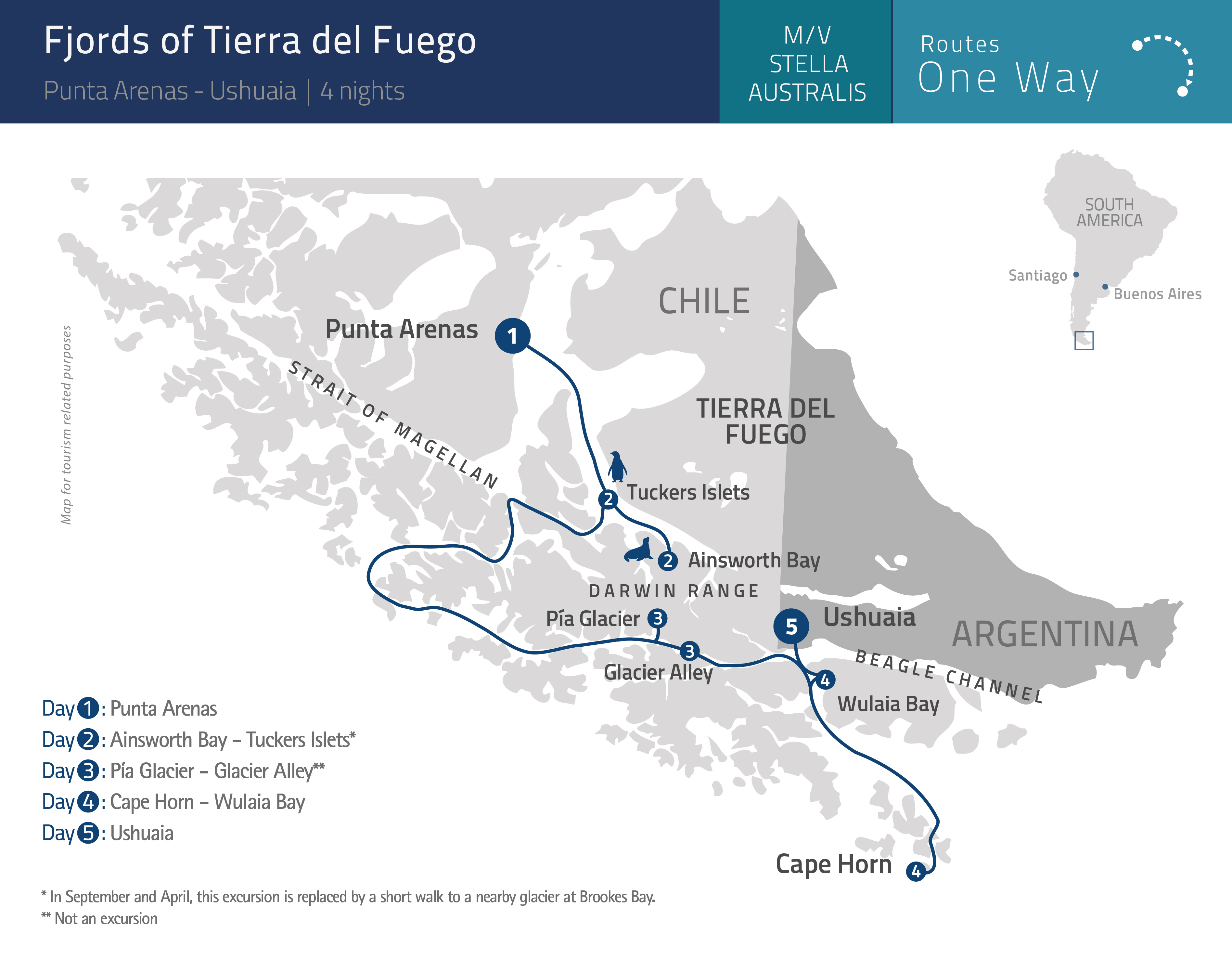
Day 1: Punta Arenas
Check in at 1385 O’Higgins Street (Arturo Prat Port) in Punta Arenas between 13:00 and 17:00 (1-5 PM) on the day of your cruise departure. Board the M/V Stella Australis (6 PM). After a welcoming toast and introduction of captain and crew, the ship departs for one of the remotest corners of planet Earth. During the night we cross the Strait of Magellan and enter the labyrinth of channels that define the southern extreme of Patagonian. The twinkling lights of Punta Arenas gradually fade into the distance as we enter the Whiteside Canal between Darwin Island and Isla Grande de Tierra del Fuego.
By dawn the ship is sailing up Admiralty Sound (Seno Almirantazgo), a spectacular offshoot of the Strait of Magellan that stretches nearly halfway across Tierra del Fuego. The snowcapped peaks of Karukinka Natural Park stretch along the north side of the sound, while the south shore is defined by the deep fjords and broad bays of Alberto de Agostini National Park. We go ashore at Ainsworth Bay, which harbors copious bird life and a colony of southern elephant seals which can sometimes be spotted from the Zodiacs. Two guided excursions are available: one is along the edge of a stream, peat bog and beaver habitat to a waterfall-and-moss-covered rock face tucked deep inside a pristine sub-polar forest; the other is a more strenuous hike along the crest of a glacial moraine. Both afford views of Marinelli Glacier and the Darwin Mountains.
Leaving Ainsworth Bay behind, we sail west along the sound to the Tucker Islets. After lunch, we board the Zodiacs again for a close-up view of the Magellan penguins that inhabit the tiny islands. More than 4,000 penguins use Tucker as a place to nest, give birth and nurture their chicks. Many other bird species also frequent the area including king cormorants, oystercatchers, Chilean skuas, kelp geese, dolphin gulls, eagles and even the occasional Andean condor. In September and April — when the penguins live elsewhere — this excursion is replaced by a short walk to a glacier at nearby stunning Brookes Bay.
Overnight we sail around the western end of Tierra del Fuego via the very narrow Gabrial Channel, Magdalena Channel and Cockburn Channel. After rounding the remote Brecknock Peninsula, Stella Australis tacks eastward and enters the Beagle Channel again. By morning we are entering Pia Fjord and boarding the Zodiacs for a shore excursion to Pia Glacier. After disembarking we take a short hike to gain a panoramic view of the spectacular glacier, which extends from the mountaintops down to the sea or a longer much more difficult walk up a lateral moraine of the old Pia Glacier.
No one knows for certain how the hulking mass of snow and ice got its feminine moniker, but one theory says it was named for Princess Maria Pia of Savoy (1847-1911), daughter of the Italian king.
Back onboard the ship, we continue east along the Beagle Channel through an area called Glacier Alley. Living up to its name, the passage features a number of impressive tidewater glaciers flowing down from the Darwin Mountains and Darwin Ice Sheet on the north shore. Most of them named after European countries — Holland, Italy, Germany, Spain and France.
During the early morning we navigate the narrow Murray Channel between Navarino and Hoste islands and drop anchor at historic Wulaia Bay, one of the few places in the archipelago where the human history is just as compelling as the natural environment. Originally the site of one of the region’s largest Yámana aboriginal settlements, the bay was described by Charles Darwin and sketched by Captain FitzRoy in the 1830s during their voyages on the HMS Beagle. This area is also renow- ned for its mesmerizing beauty and dramatic geography. After a visit to the Australis-sponsored museum in the old radio station — which is especially strong on the Yámana people and European missionaries in the area — passengers have a choice of three hikes (of increasing degrees of difficulty) that ascend the heavily wooden mountain behind the bay. On all of these you will be strolling through an enchanted Magellan forest of lengas, coigües, canelos, ferns, and other endemic fauna to reach a panoramic viewpoint overlooking the bay. Before leaving Wulaia Bay, drop something into the wooden mail barrel inside the museum – letters or postcards meant to be hand delivered by future travelers – an ancient mariner tradition revived by Australis.
In the afternoon we cruise across Nassau Bay into the remote archipelago that includes Cape Horn National Park. Weather and sea conditions permitting, we shall go ashore on the windswept island that harbors legendary Cape Horn (Cabo de Hornos). Discovered in 1616 by a Dutch maritime expedition — and named after the town of Hoorn in West Friesland — Cape Horn is a sheer 425-meter (1,394-foot) high rocky promontory overlooking the turbulent waters of the Drake Passage. For many years it was the only navigation route between the Pacific and Atlantic, and was often referred to as the “End of the Earth.” The park was declared a World Biosphere Reserve by UNESCO in 2005. The Chilean navy maintains a permanent lighthouse on the island, staffed by a lightkeeper and his family, as well as the tiny Stella Maris Chapel and modern Cape Horn Monument.
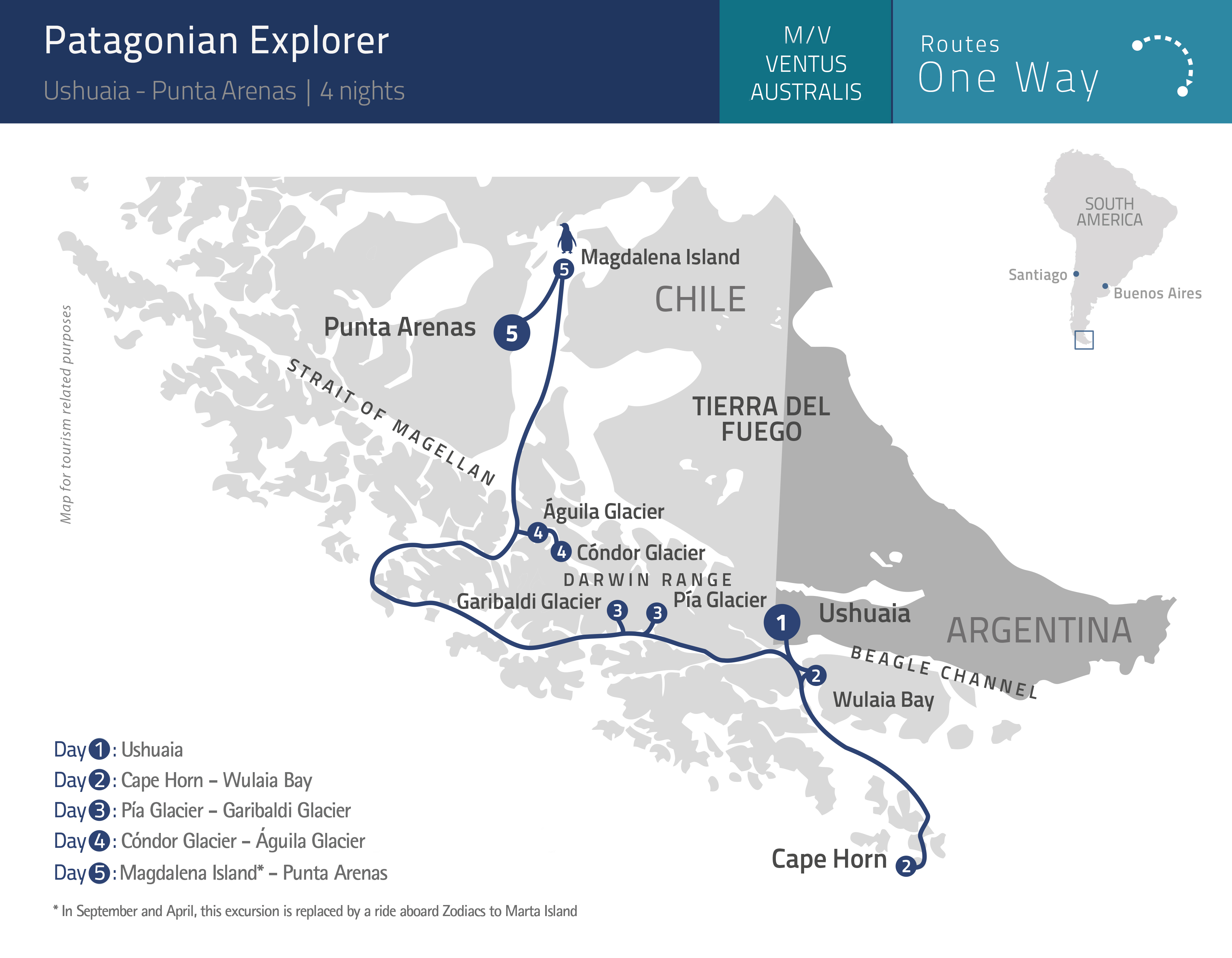
The following morning we sail into Argentine waters and dock in Ushuaia, the world’s southernmost city. Disembarkation is scheduled at 8 AM. You have almost a full day to explore Ushuaia which was founded in 1884 and was one of the original points of contact between the indigenous Yámana and European cultures. The city’s name derives from the Yámana word for ‘pene- trating bay.’ With around 65,000 inhabitants, Ushuaia is the second largest city in Tierra del Fuego (after Rio Grande) and is surrounded by the Southernmost Andes peaks. Among its highlights is the Prison at the End of the World, a former peniten- tiary that is now a maritime museum that features an Antarctic collection and memorial to those once incarcerated there. The city is also good for shopping (especially locally made chocolate) or hanging out in its many cafes.
Passengers are required to reboard Ventus Australis at 17:30 (5:30 PM). After a welcoming toast and introduction of captain and crew to new passengers joining the cruise, the ship departs for more adventures in Tierra del Fuego. During the night we traverse the Beagle Channel, cross back into Chilean territorial waters, and turn into the narrow Murray Channel between Navarino and Hoste islands.
Around the break of dawn, Stella Australis crosses Nassau Bay and enters the remote archipelago that comprises Cape Horn National Park. Weather and sea conditions permitting, we shall go ashore on the windswept island that harbors legendary Cape Horn (Cabo de Hornos). Discovered in 1616 by a Dutch maritime expedition — and named after the town of Hoorn in West Friesland — Cape Horn is a sheer 425-meter (1,394-foot) high rocky promontory overlooking the turbulent waters of the Drake Passage. For many years it was the only navigation route between the Pacific and Atlantic, and was often referred to as the “End of the Earth.” The park was declared a World Biosphere Reserve by UNESCO in 2005. The Chilean navy maintains a permanent lighthouse on the island, staffed by a lightkeeper and his family, as well as the tiny Stella Maris Chapel and modern Cape Horn Monument (currently awaiting repair after being damaged by fierce winds).
Sailing back across Nassau Bay, we anchor at fabled Wulaia Bay, one of the few places in the archipelago where the human history is just as compelling as the natural environment. Originally the site of one of the region’s largest Yámana aboriginal settlements, the bay was described by Charles Darwin and sketched by Captain FitzRoy in the 1830s during their voyages on HMS Beagle. This area is also renowned for its mesmerizing beauty and dramatic geography. After a visit to the Australis-sponsored museum in the old radio station — which is especially strong on the Yámana people and European missionaries in the area — passengers have a choice of three hikes (of increasing degrees of difficulty) that ascend the heavily wooded mountain behind the bay. On all of these you stroll through an enchanted Magellanic forest of lengas, coigües, canelos and ferns to reach panoramic viewpoints overlooking the bay.
Overnight we sail around the western end of Tierra del Fuego via the very narrow Gabrial Channel, Magdalena Chan- nel and Cockburn Channel. After rounding the remote Brecknock Peninsula, Ventus Australis tacks eastward and enters the Beagle Channel again. By morning we are entering Pia Fjord and boarding the Zodiacs for a shore excur- sion to Pia Glacier.After disembarking we take a short hike to gain a panoramic view of the spectacular glacier, which extends from the mountaintops down to the sea or a longer much more difficult walk up a lateral moraine of the old Pia Glacier.
No one knows for certain how the hulking mass of snow and ice got its feminine moniker, but one theory says it was named for Princess Maria Pia of Savoy (1847-1911), daughter of the Italian king.
Making our way further west along the Beagle Channel, we enter another long fjord and drop anchor near Garibaldi Glacier for another shore excursion. Garibaldi is one of only three glaciers in Patagonia gaining mass rather than staying the same or slowly shrinking. This time we hike through virgin Magellanic forest to a glacial waterfall, a towering wall of ferns and moss, and spectacular viewpoints looking down on the glacier and fjord. The walk is demanding — very steep, negligible trail, rough footing — and not for everyone. For those who choose to stay onboard, our captain will point the bow towards the beautiful sky blue Garibaldi Glacier so everyone can enjoy the panoramic view from the upper decks.
Early in the morning, we will sail through the Cockburn Channel and enter Agostini Sound. From there it is possible to see the glaciers that descend from the middle of the Darwin Mountain Range — some of them reaching the water. This mor- ning, we will disembark and go for an easy walk around a lagoon, which was formed by the melting of the Águila Glacier. We will reach a spot right in front of that glacier with stunning views. In the afternoon, we will approach the Condor Glacier via Zodiac — and hopefully see some of the abundant Andean Condors in the area.
After an overnight cruise through Magdalena Channel and back into the Strait of Magellan, we anchor off Magdalena Island, which lies about halfway between Tierra del Fuego and the Chilean mainland. Crowned by a distinctive lighthouse, the island used to be an essential source of supplies for navigators and explorers and is inhabited by an immense colony of Magellanic penguins. At the break of dawn, weather permitting, we go ashore and hike a path that leads through thou- sands of penguins to a small museum lodged inside the vintage 1902 lighthouse. Many other bird species are also found on the island. In September and April — when the penguins dwell elsewhere — this excursion is replaced by a ride aboard Zodiacs to Marta Island to observe South American sea lions. After a short cruise south along the strait, disembarkation at Punta Arenas is scheduled for around 11:30 AM.
*Camera extension poles are prohibited on Magdalena Island

Notes
Rates include: accommodation, sea transportation, all meals, open bar when on duty (without additional cost for wines, beverages, and liquors), shore excursions and onboard entertainment
Rates do not include: Optional tours and transportation are niot included in the cruise rate. Rate does not uinclude port tax , migration fee and national park fee. The cost per person is the following:
These costs may be modified by the port authorities of each country
Reservations, Deposits and Payments
A deposit of US$ 400.00 per passenger is required to guarantee a tentative reservation. The final payment must be received 70 days before the departure of the cruise.
Cancellation Policy
The following penalties will apply in case of cancellations as soon as receives written
Notice Fine

Notes
Rates include: accommodation, sea transportation, all meals, open bar when on duty (without additional cost for wines, beverages, and liquors), shore excursions and onboard entertainment
Rates do not include: Optional tours and transportation are niot included in the cruise rate. Rate does not uinclude port tax , migration fee and national park fee. The cost per person is the following:
These costs may be modified by the port authorities of each country
Reservations, Deposits and Payments
A deposit of US$ 400.00 per passenger is required to guarantee a tentative reservation. The final payment must be received 70 days before the departure of the cruise.
Cancellation Policy
The following penalties will apply in case of cancellations as soon as receives written
Notice Fine